

How to Identify Real Gemstone Jewelry: 7 Proven Steps
Table of Contents
- How to Identify Real Gemstone Jewelry: A Step-by-Step Approach
- Start With Visual Inspection in Bright Light
- Use Gemstone Identification Tools Like a Jeweler's Loupe
- Safe Gemstone Tests at Home (And What They Can't Tell You)
- Natural vs. Synthetic Gemstones: What the Difference Means for Buyers
- Gemstone Certification and Appraisal: When to Go Pro
- Jewelry-Specific Checks: Settings, Wear, and Craftsmanship
- Conclusion
- Frequently Asked Questions
Last Updated: October 12, 2026
How to Identify Real Gemstone Jewelry: A Step-by-Step Approach
Gemstone identification means examining a stone's color, clarity, and structure to judge whether it is natural, lab-grown, treated, or imitation. Learning how to identify real gemstone jewelry starts with your eyes, a bright light, and a few simple checks.
Here is the honest part most guides skip: no at-home test can prove a stone is genuine, home checks only raise or lower your confidence.
Start With Visual Inspection in Bright Light
Visual inspection is the first and most useful step. Hold the piece near a window in natural daylight, not under warm indoor bulbs, which hide color, clarity, and surface detail.
Reading Color, Clarity, and Luster
Look at the stone from several angles. A real gemstone usually shows uneven color, small irregularities, and depth inside. Glass and plastic look flat and perfectly even.
- Color: natural stones often shift shade across the surface. Dyed stones pool color in cracks.
- Clarity: look through the stone. Real gems often carry tiny inclusions, which are natural marks inside the stone.
- Luster: the surface should reflect light with a soft, deep glow, not a dull or plastic sheen.
Compare the stone to the product description. A genuine seller states the stone type, treatment, and origin; a vague listing is a warning sign.
Use Gemstone Identification Tools Like a Jeweler's Loupe
A jeweler's loupe is a small 10x magnifying lens and the best low-cost tool for gemstone identification at home.
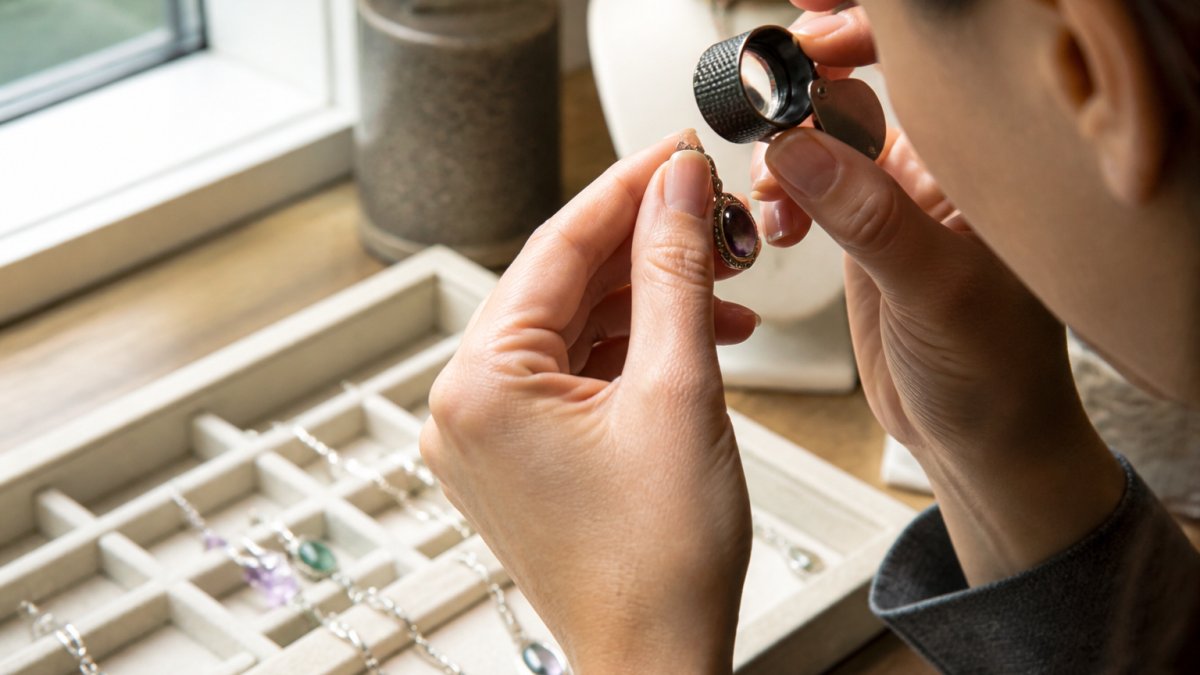
Under magnification, look for:
- Inclusions: tiny natural marks, crystals, or feathers inside the stone.
- Bubbles: round gas bubbles usually point to glass or plastic.
- Growth lines: curved or straight bands can suggest a lab-grown or synthetic stone.
Inclusions are not flaws, they are often the best proof a stone formed in nature.
Safe Gemstone Tests at Home (And What They Can't Tell You)
Safe gemstone tests at home support your visual inspection, but none confirm authenticity alone. Use them as clues, not verdicts, and skip the water test on any piece with a glued setting or soft stone.
The Water Test, Breath Test, and Weight Check
- Water test: real gemstones are denser than glass and sink quickly; glass and plastic may float. Loose stones only, never finished jewelry.
- Breath test: real stones fog briefly and clear fast; glass holds fog longer.
- Weight check: real stones feel heavier than plastic or glass of the same size, a rough check, not a measurement.
| Test | What It Suggests | What It Cannot Prove |
|---|---|---|
| Water test | Higher density, possibly real | Lab-grown stones also sink |
| Breath test | Fast fog clearance | Some treated stones pass too |
| Weight check | Feels dense and solid | Not precise without a scale |
| Loupe check | Inclusions or bubbles | A gemologist still needs to confirm |
Natural vs. Synthetic Gemstones: What the Difference Means for Buyers
Most guides lump every non-mined stone into one bucket called "fake." That is wrong, and it costs buyers money: a stone can be genuine and still not be natural. These four categories carry different value, care needs, and disclosure rules.
The four categories, defined
- Natural: Formed in the earth without human intervention. It may still have been treated after mining (heated, oiled, irradiated), which is standard for many species. Natural means "not made in a lab," not "untouched."
- Lab-grown (synthetic or created): Grown in a lab with the same chemical composition and crystal structure as the natural stone, a lab-grown ruby is corundum, a lab-grown diamond is carbon. These are genuine gemstones by material, just not mined, and typically sell for a fraction of natural prices, a gap that widens with size and quality.
- Treated: A natural stone enhanced to improve color or clarity. Heating is near-universal for blue sapphires, rubies, and tanzanite; dyeing is common in agate, turquoise, and lapis; fracture filling with resin or glass is common in emeralds and rubies. Still a real stone, but treatment affects price, durability, and cleaning.
Why the distinction matters at the counter
The practical difference is price and disclosure, not beauty. A natural, untreated blue sapphire can cost many times more than a heated one, which costs more than a lab-grown one of the same look.
Buyers overpay when a seller uses a vague word like "genuine" without naming the category. "Genuine" is not a regulated grade, it can describe a natural, lab-grown, or treated stone.
What sellers are required to disclose
The Federal Trade Commission's Jewelry Guides govern how gemstones and jewelry must be described in advertising and labeling. Sellers must clearly disclose:
- That a stone is lab-grown or synthetic, and they may not use "real," "genuine," "natural," or "precious" to describe it without qualification.
- That a stone has been treated, when the treatment is not permanent or when it significantly affects value, for example, fracture filling, dyeing, or surface coating.
- The identity of the stone, using recognized gemological names rather than trademarked or invented ones.
You can read the current guidance at the FTC Jewelry Guides and gemstone disclosure rules. If a listing uses a trade name you cannot find in a standard gemological reference, treat that as a red flag.
A quick way to sort a listing
When you read a product page, ask three questions in order:
- Does it name the stone species (for example, "blue sapphire" rather than "blue gem")?
- Does it state the origin category, natural, lab-grown, or imitation?
- Does it state any treatment, heated, dyed, filled, or none?
A listing that answers all three is doing its job. A listing that answers none is asking you to guess, and guessing is how buyers end up paying natural prices for a lab-grown stone.
Gemstone Certification and Appraisal: When to Go Pro
Gemstone certification and appraisal is the only way to confirm what a stone actually is. A gemologist measures refractive index, specific gravity, and internal structure, then issues a report. For any piece worth more than a few hundred dollars, it is worth the cost.
Dark Red Tigers Eye Earrings →
Where to go:
- A certified gemologist at an independent lab.
- A local jeweler who offers appraisal services.
- A gemological testing lab that issues written reports.
Ask for the report in writing, and keep it with the piece. If a seller cannot provide certification for a high-value stone, walk away.
Jewelry-Specific Checks: Settings, Wear, and Craftsmanship
Almost every guide to spotting real gemstones tells you to look at the stone, but almost none explain how to inspect a stone already mounted in jewelry, the situation you are actually in. A mounted stone hides its pavilion (the bottom half), and the setting itself can be a tell. Here is what to check, in order.
Inspect the setting before the stone
- Prongs: Count them and check that each grips the stone evenly. Look for gaps between prong tip and stone, bent or uneven prongs, or a prong filed flat. A stone held by two of four prongs is waiting to fall out.
- Bezel and channel settings: In a bezel, the metal should wrap the stone smoothly with no edge gaps. In a channel, stones should sit level and flush, with no rocking when pressed gently.
- Glue: Any visible adhesive around the girdle or under the stone is a strong sign of an imitation or a repair. Real gemstones in fine jewelry are held by metal, not glue.
Read the metal marks
Stamps tell you what the metal is and cross-check the whole piece. Common marks inside a band, on a clasp, or on a bail:
- 925 or Sterling, sterling silver, 92.5% silver.
- 14K, 18K, 10K, gold content in karats. 24K is pure gold and too soft for most settings.
- 585, 750, 417, the same gold purities expressed in parts per thousand (14K, 18K, 10K respectively).
A missing stamp is not proof of a fake, small or antique pieces are sometimes unstamped, but a stamp contradicting the seller's description is a serious problem.
Inspect the mounted stone safely
You cannot run a water test or a weight check on a set stone. What you can do:
- Loupe the crown and girdle. The crown is the top of the stone; the girdle is the thin edge where it meets the setting. Under 10x magnification, look for the inclusions and growth features described earlier. The girdle is the hardest area to fake and the easiest place to spot glass or a glued-in simulant.
- Tilt the stone under a single light source. A natural faceted stone shows sharp, bright flashes from inside; glass looks flatter with less contrast between bright and dark facets.
- Check for abrasion at the facet edges. Real stones wear differently than glass. Rounded, frosted facet junctions on a stone described as new are a warning sign.
Check wear and craftsmanship
- Wear: Look for loose stones (tap gently near your ear and listen for a rattle), scratches on the metal, and plating worn through to a different color underneath.
- Craftsmanship: Seams, joins, and solder points should be clean and consistent, and prongs uniform. A well-made piece holds its stones and its shape.
Match the stone to the wear it will get
Durability matters as much as authenticity for jewelry you actually wear. On the Mohs scale, diamond is 10, corundum (ruby and sapphire) is 9, quartz (including amethyst and agate) is 7, and opal is roughly 5.5 to 6.5. A stone below 7 scratches from ordinary dust and daily contact, so it belongs in earrings or pendants rather than a daily-wear ring.
Tigers eye, at about 7, is a durable choice with a chatoyant effect, a band of light that shifts as the stone moves. Our Dark Red Tigers Eye Earrings show that effect clearly, and the 1.5-inch stones work for office days and evenings out. For a softer look, the Agate Chakra Earrings use natural agate stones and pair well with everyday outfits.


Natural stones vary from piece to piece. That variation is a sign of authenticity, not a defect.
When you buy a mounted stone, ask the seller for a clear photo of the stone's back and a written statement of the stone species, origin category, and treatment. A seller who will not provide those is telling you something.
Conclusion
Spotting a fake takes patience, and no single test does the job alone. Start with bright light, add a loupe, and use home tests as clues rather than proof.
Our collection features natural stones, honest product descriptions, and handcrafted pieces. Our agate chakra earrings and tigers eye dangles are designed for daily wear, with stone type and details on every product page.
Frequently Asked Questions
How can you tell if gemstone jewelry is real?
Start with visual inspection in bright light: look for natural color variation, inclusions, and irregularities rather than perfect uniformity. Use a jeweler's loupe to check for bubbles or growth lines. A genuine gemstone often feels cooler and denser than glass. For certainty, ask for a gemological report from a recognized lab. No single home test proves authenticity, so combine several checks and treat any too-good-to-be-true price as a red flag.
What is the difference between a genuine, lab-grown, and simulated gemstone?
A genuine gemstone is mined from the earth. A lab-grown gemstone has the same chemical and physical properties but is created in a lab. A simulated or imitation stone is something else entirely, like glass or plastic, designed to look like the real thing. Treated stones are genuine but enhanced with heat or dye. Each category has different value and durability, so ask sellers to disclose which type you are buying.
Can you identify a real gemstone with a home test?
Home tests can rule out obvious fakes but cannot confirm authenticity. The water test checks density, the breath test looks at how fog clears, and a magnifying glass reveals bubbles or growth lines. These are safe gemstone tests at home, but they have limits: lab-grown stones can pass them, and some treatments are invisible without equipment. Use them as a first filter, then rely on a gemologist for a definitive answer.
Does a gemstone certificate prove that a stone is real?
A certificate from an independent gemological lab confirms what the stone is, including whether it is natural, lab-grown, or treated. It does not prove the seller is honest, so match the certificate to the exact stone and check the report number with the lab. For expensive pieces, a gemstone certification and appraisal protects your purchase and helps with insurance. Without a report, you are relying on the seller's word alone.