

How to Spot Fake Agate Stones: 7 Reliable Tests
Table of Contents
- 1. Start With a Visual Inspection: Banding, Color, and Pattern
- 2. How to Tell If Agate Is Real: Translucency, Inclusions, and Weight
- 3. Agate vs. Glass: Bubbles, Temperature, and Surface Clues
- 4. How to Identify Dyed Agate vs. Natural Color
- 5. Agate Identification Tests: A Safe Step-by-Step Protocol
- 6. Natural Agate, Treated Agate, or Imitation: Sorting the Three Categories
- 7. When to Get Professional Identification and What to Ask the Seller
- Frequently Asked Questions
Last Updated: October 19, 2026
1. Start With a Visual Inspection: Banding, Color, and Pattern
Fake agate is any stone sold as natural agate that is actually glass, plastic, dyed quartz, or a printed imitation. The most reliable first clue is the banding. Genuine agate forms when silica layers build up inside a volcanic cavity over thousands of years, so its bands are irregular, uneven in width, and slightly wavy. At Bijouterie Mercantile, we handle natural agate daily, and the tell is almost always in the pattern rather than the color.
Real agate rarely looks perfect. Bands curve, pinch, and change thickness. Some layers turn cloudy while others stay clear.
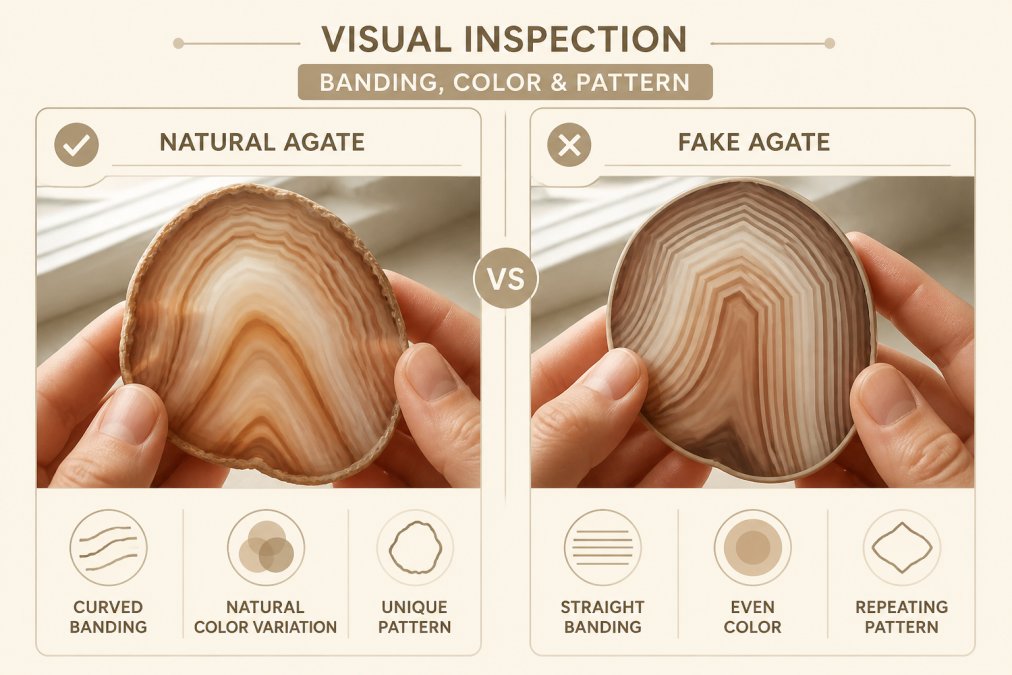
Natural Banding vs. Printed or Painted Patterns
Printed patterns repeat. Look for the same swirl appearing twice, or a design that stops dead at the stone's edge. Natural bands flow through the stone and continue on the reverse side. If the pattern only sits on the surface, it is a fake agate.
Turn the stone under a lamp and tilt it slowly. Real banding shifts in depth as the light moves. A printed layer stays flat.
- Bands of uneven width: likely natural
- Bands that mirror each other exactly: likely printed
- Pattern that vanishes at the edges: likely painted
- Color that pools in cracks: likely dyed
2. How to Tell If Agate Is Real: Translucency, Inclusions, and Weight
How to tell if agate is real comes down to three checks: how light passes through it, what sits inside it, and how heavy it feels. Real agate is usually semi-translucent, so a thin slice glows at the edges when backlit. Hold a piece up to a window and look for a soft, uneven glow.
Inclusions matter too. Natural agate often carries tiny mineral specks, cloudy patches, or fine moss-like growth, which is why moss agate looks the way it does. Perfectly clear, uniform stone with zero internal detail is suspicious.
Weight is the third check. Agate is a dense stone, so it feels heavier than its size suggests. Plastic imitations feel light and almost hollow by comparison. Glass sits closer to real agate in weight, which is why the next section matters.
3. Agate vs. Glass: Bubbles, Temperature, and Surface Clues
Agate vs. glass is the comparison that trips up most buyers, because dyed glass can mimic banding well. The giveaway is air bubbles. Glass pours into molds, and tiny round bubbles get trapped inside. Real agate has no bubbles, only irregular inclusions.
Temperature helps as a backup. Agate feels cool to the touch and warms slowly. Glass warms fast, and plastic feels room temperature almost immediately.
Surface wear tells a story too. Natural stone develops small scuffs and pits over time. Glass chips in curved, shell-like flakes. If a "vintage" piece looks flawless and glassy, treat it with suspicion.
4. How to Identify Dyed Agate vs. Natural Color
How to identify dyed agate starts with color that looks too even. Natural agate runs in earthy tones: grays, creams, browns, muted reds, and pale blues. Saturated neon pink, electric blue, or vivid purple almost always signals dye.
Look at the cracks. Dye seeps into fractures and collects there, so the lines look darker than the surrounding stone. Natural color sits inside the bands, not in the fissures.
Heat treatment is a separate issue. Many agates are heated to deepen reds and browns, and this is widely accepted in the trade. Heat-treated stone is still genuine agate. Dye is different, because it adds color the stone never had.
Colorful Agate Oval Earrings →
- Natural color: uneven, earthy, follows the banding
- Dyed color: uniform, bright, pools in cracks
- Heat-treated color: deeper reds and browns, still natural stone
5. Agate Identification Tests: A Safe Step-by-Step Protocol
Agate identification tests range from simple visual checks to a hardness test, and the order matters. Start gentle so you never damage a piece you might keep. Here is the protocol we suggest.
- Inspect in daylight. Look for irregular banding and natural variation. Time: 2 minutes.
- Backlight the stone. Check for semi-translucency and internal cloudiness. Time: 1 minute.
- Feel for temperature. Cool to the touch favors stone over plastic. Time: seconds.
- Use a loupe. Search for air bubbles, printed dots, or dye in cracks. Time: 1 minute.
- Weigh it in your hand. Compare against a known stone if you can. Time: seconds.
- Scratch test, last and carefully. See below before you try it.
The Scratch Test and What It Can (and Cannot) Prove
Agate ranks about 6.5 to 7 on the Mohs hardness scale, so a steel nail should not scratch it. Glass ranks lower and scratches easily. That sounds decisive, but it is not.
The scratch test only separates hard stone from soft imitations. It cannot tell natural agate from dyed agate, and it cannot tell agate from quartz or chalcedony. It also leaves a mark, so never test a finished piece you plan to wear. Test the base of a cabochon or skip it entirely.
6. Natural Agate, Treated Agate, or Imitation: Sorting the Three Categories
Most buyers lump everything into real or fake, and that is the mistake. There are three categories, and only one is a true fake agate.
| Category | What It Is | How to Spot It | Verdict |
|---|---|---|---|
| Natural agate | Untreated stone with natural bands | Irregular banding, earthy color, cool feel | Genuine |
| Treated agate | Real agate, dyed or heat-treated | Bright even color, dye in cracks | Genuine but altered |
| Imitation | Glass, plastic, or printed stone | Bubbles, printed pattern, light weight | Fake |
Treated natural agate is still agate. The stone is real, the color is enhanced, and a fair seller says so. Imitation is a different material entirely. Ask which category a piece falls into before you buy.
7. When to Get Professional Identification and What to Ask the Seller
Professional identification makes sense for any piece you plan to spend real money on or pass down. A gemologist at a qualified lab can confirm the material and issue written documentation. For everyday pieces, a good seller and a clear return policy usually cover you.
Ask the seller three questions before you buy:
- Is this natural, treated, or imitation?
- What is your return policy if a jeweler disagrees?
- Can you describe the banding and inclusions in writing?
A straight answer is a good sign. Vague replies are not.
At Bijouterie Mercantile, we describe our agate pieces as natural stone and stand behind that. Our Agate Stone Necklace shows the irregular banding real agate should have, and our Agate Chakra Earrings are crafted with natural agate stones. If you want to see what genuine banding looks like up close, our Colorful Agate Oval Earrings are a good place to start.


Frequently Asked Questions
How can you tell if an agate stone is real?
Look for natural banding that curves and varies in thickness, subtle color shifts rather than flat saturation, and slight translucency when held to light. Real agate feels cool and dense, and it usually shows small internal inclusions or irregular patterns. A magnifying glass helps you check for air bubbles, which point to glass, or printed patterns that sit on the surface. No single check proves authenticity, so combine visual inspection, the light test, and a feel-and-weight check before deciding.
How can you tell real agate from glass?
Glass imitations usually have perfectly round air bubbles, a warmer feel at room temperature, and uniform color with no natural banding. Real agate is cool to the touch, denser, and its bands follow irregular, organic lines. Under light, glass often looks too clear or too evenly colored. A gentle scratch test with a steel nail can help: agate ranks around 6.5 to 7 on the Mohs scale and resists a steel nail, while glass scratches. Skip the scratch test on polished jewelry you plan to keep.
How can you tell if agate has been dyed?
Dyed agate often shows unnaturally saturated color, especially bright pinks, blues, and purples that rarely occur naturally. The dye tends to concentrate in cracks and along band edges, so look for darker lines in fractures. Natural agate usually has earthy tones with gradual transitions. If the color looks painted on rather than grown into the stone, treat it as dyed. Dyeing is common and not the same as faking, but sellers should disclose it.
Can real agate have bright or unusual colors?
Yes, real agate can show vivid colors, but most bright pinks, electric blues, and neon greens on the market are dyed or heat-treated. Natural agate typically runs in earthy tones: grays, whites, browns, reds, and muted blues. Heat treatment can deepen reds and oranges and is widely accepted in the trade when disclosed. If a seller claims a bright color is natural, ask for documentation. Price is a clue too: vivid natural-color agate usually costs far more than $10 to $15 earrings.
Knowing how to spot fake agate stones protects every purchase you make, whether from us or anywhere else. Learn the banding, check for bubbles, and ask sellers direct questions. When you are ready for pieces you can trust, browse the Bijouterie Mercantile agate collection and subscribe to our emails for first looks at new arrivals.