

Authentic Gemstone Earrings for Sale: 2026 Buyer's Guide
Table of Contents
- Authentic Gemstone Earrings for Sale: What $8 to $10 Actually Buys
- How to Tell If a Gemstone Is Real Before You Buy
- Handmade Gemstone Earrings: Why Craftsmanship Changes the Price
- Stone Types, Styles, and Metals in Our Collection
- Gemstone Earring Care: Cleaning, Storage, and Everyday Wear
- Earring Backs, Weight, and Fit for Sensitive Ears
- Sourcing, Treatments, and What Sellers Rarely Tell You
- Choosing Your Pair: Occasion, Face Shape, and Gifting
- Frequently Asked Questions
Last Updated: October 14, 2026
Authentic Gemstone Earrings for Sale: What $8 to $10 Actually Buys
Authentic gemstone earrings for sale at Bijouterie Mercantile start at $8 and top out at $10, which raises an obvious question: how can real stone cost that little?
Gemstone earrings are built around a cut and polished natural stone, usually set in sterling silver or gold-tone metal and finished with a post, hook, or lever back. A $10 agate oval and a $200 amethyst drop can both be genuine; the difference is rarity, not honesty.

How to Tell If a Gemstone Is Real Before You Buy
The fastest way to tell if a gemstone is real is to look for natural variation: no two genuine stones share the exact same pattern, color depth, or internal markings.
Temperature and weight are the next signals. Real stone feels cool against your skin and stays cool longer than plastic or resin.
Then check the setting. The Federal Trade Commission's guidance on jewelry advertising sets the standard sellers are supposed to follow when describing gemstones, and it's worth knowing what claims are actually regulated.
Five At-Home Checks for Natural Gemstones
- Pattern test: Look for irregular banding, inclusions, or color shifts. Perfect uniformity usually means synthetic.
- Temperature test: Hold the stone to your cheek. Real stone stays cool for several seconds.
- Weight test: Compare against a similar-size piece of glass or plastic. Genuine stone feels denser.
- Scratch test (careful): Agate and tiger's eye rank 6.5-7 on the Mohs scale and resist a light fingernail or coin edge. Don't scratch a stone you plan to keep.
- Light test: Hold it to a lamp. Natural stones often reveal internal texture or fibrous structure that glass lacks.
Handmade Gemstone Earrings: Why Craftsmanship Changes the Price
Handmade gemstone earrings cost more than mass-produced pairs because a person, not a machine, selects, matches, and finishes each stone.
Mass-produced earrings are often assembled from pre-cut stones sorted by size alone, skipping color and pattern matching, so one earring looks noticeably different from the other, the most common complaint buyers raise about budget gemstone jewelry.
At our price point, the craftsmanship cost is absorbed by keeping the stone selection focused: agate and tiger's eye are affordable enough that a maker can spend time matching pairs without inflating the price.
Stone Types, Styles, and Metals in Our Collection
Our collection centers on agate and tiger's eye, chosen for durability, color range, and how well they hold a polish. Both sit around 6.5 to 7 on the Mohs hardness scale, the range where a stone resists everyday knocks from keys, desk edges, and seatbelts without chipping the way softer stones like opal or pearl can, which is why these two work for daily wear.
Styles span the range most buyers want:
- Stud earrings for a low-profile, office-friendly look
- Drop earrings for a bit of movement and length
- Dangle earrings for a bolder, bohemian statement
- Hoop earrings and huggie earrings for a close-fitting everyday option
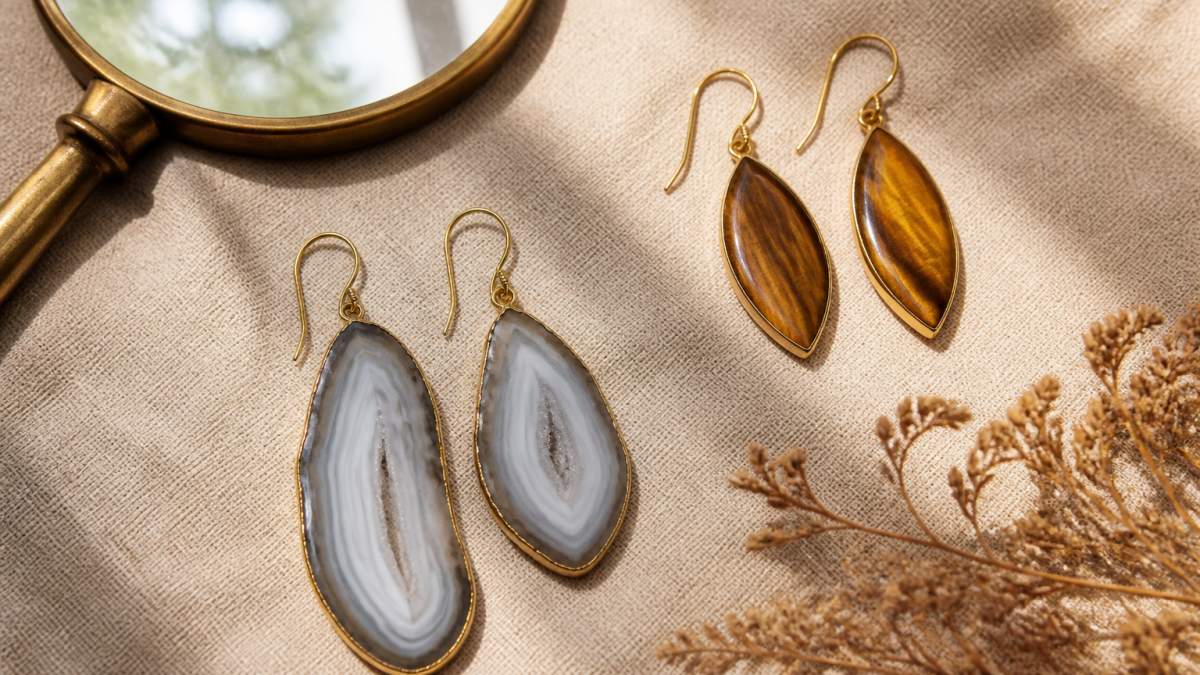
Agate and Tiger's Eye: What Each Stone Does for a Look
Agate brings color variety. It forms in bands ranging from soft pastels to deep, saturated tones, making it easy to match to an outfit or a mood, and as a form of chalcedony it takes a smooth, even polish. Our Colorful Agate Oval Earrings use that range to catch light across a polished surface.
Tiger's eye brings depth instead of color. The Dark Red Tigers Eye Earrings and the Dark Tigers Eye Dangles both lean on that effect, while the Black Red Tigers Eye Earrings push it toward a bolder, more dramatic look.


What Actually Drives the Price of a Gemstone Earring
Two similar-looking pairs can sit at very different prices. The gap usually comes down to four things:
- Stone rarity. Agate and tiger's eye are abundant, which is why they stay affordable. Amethyst, garnet, and blue topaz cost more. Emerald, ruby, and sapphire cost more again.
- Stone size and cut. A larger stone uses more rough material, and a precision cut wastes more of it. A well-cut smaller stone can cost more than a poorly cut larger one.
- Setting and metal. A hand-set stone in sterling silver costs more to produce than a glued stone in plated base metal. The metal alone can be a large share of the price at the low end.
- Labor and matching. Selecting two stones that match in color and pattern takes time. That labor is invisible in a photo but shows up in how the pair looks when worn.
Treatments You Should Ask About
Most gemstones sold today have been treated in some way, and treatment is not automatically a problem. Heat treatment is standard to deepen color or improve clarity, and it is stable and permanent for stones like agate and tiger's eye.
Before buying, ask directly:
- Is the color natural or treated?
- Is the stone solid or a composite made from pieces bonded together?
- Where was the stone sourced?
The Federal Trade Commission's guidance on jewelry advertising sets the standard sellers are supposed to follow when describing gemstones, including treatment disclosure. It is worth knowing what claims are actually regulated before you rely on them.
Gemstone Earring Care: Cleaning, Storage, and Everyday Wear
Gemstone earring care comes down to three habits: clean gently, store separately, and keep stones away from harsh chemicals.
Clean with a soft, damp cloth and mild soap. Dry fully before storing.
Store each pair in its own pouch or compartment; stones rubbing against each other or harder jewelry will dull over months.
Put earrings on last and take them off first. The Gemological Institute of America's gemstone care guidance covers stone-specific cleaning limits if you want the detail behind each recommendation.
Earring Backs, Weight, and Fit for Sensitive Ears
Backs and weight decide whether a pair is wearable all day or gets retired after an hour. For sensitive ears, the metal touching your skin matters more than the stone.
Back types and what they suit:
Colorful Agate Oval Earrings →
| Back Type | Best For | Trade-off |
|---|---|---|
| Friction (butterfly) | Lightweight studs | Can loosen with repeated wear |
| Lever back | Dangles and drops | More secure, slightly heavier |
| Screw back | Sensitive ears, kids | Secure but slower to put on |
| Fishhook | Light dangles | Comfortable, less secure |
Weight is the other factor. A 1.5-inch dangle in a dense stone pulls on the lobe more than a stud does, and that pull shows up as soreness by day's end.
For sensitive ears, stick with hypoallergenic metals. If a pair itches within an hour, the metal is usually the cause, not the stone.
Sourcing, Treatments, and What Sellers Rarely Tell You
Sourcing and treatment disclosure is where most gemstone listings go quiet. Two sellers can list the same stone type at the same price while only one tells you whether the color is natural or enhanced.
Ask directly before buying:
- Is the color natural or treated?
- Is the stone solid or a composite?
- Where was the stone sourced?
Ethical sourcing is harder to verify at any price point, so treat vague answers as a signal. The U.S. Geological Survey's mineral resource information is a useful starting point if you want to understand where common gemstone materials originate.
A common mistake is assuming "handmade" automatically means ethically sourced. It doesn't. Handmade describes assembly, not origin. Ask about both.
Choosing Your Pair: Occasion, Face Shape, and Gifting
Occasion, face shape, and gifting needs should drive the choice, not the other way around. But the decision that matters most for whether you actually wear a pair is fit and weight.
Match the Back to the Wear
The back decides whether an earring stays put, and the wrong one is the most common reason a pair gets retired after a week.
| Back Type | Best For | Trade-off |
|---|---|---|
| Friction (butterfly) | Lightweight studs | Can loosen with repeated wear |
| Lever back | Dangles and drops | More secure, slightly heavier |
| Screw back | Sensitive ears, kids | Secure but slower to put on |
| Fishhook | Light dangles | Comfortable, less secure |
For dangles and drops, a lever back is usually safer because it closes behind the lobe and resists snagging on hair and scarves. For studs, friction backs are fine as long as the post is long enough to clear the lobe without pinching; if a stud feels tight, the post is too short, not the back.
Weight and Drop Length
Weight is the other factor that decides all-day comfort. A 1.5-inch dangle in a dense stone pulls on the lobe more than a stud does, and that pull shows up as soreness by the end of the day.
If you are new to dangles, start with a shorter drop and build up. A 0.5-inch to 1-inch drop is a comfortable entry point; drops above 2 inches look dramatic but need a secure back and a lobe that can carry the weight.
Sensitive Ears
For sensitive ears, the metal touching your skin matters more than the stone itself. If a pair itches within an hour, the metal is usually the cause, not the stone. A simple test: wear the pair for a short errand first, before committing to a full day.
Face Shape and Occasion
Face shape is a loose guide, not a rule. Longer drops tend to balance rounder faces; wider studs or hoops add width to longer faces. If unsure, mirror-test a pair before committing.
For work, lean toward short drops in neutral tones; they read polished without drawing attention. For evenings, longer dangles in darker stones add presence.
Gifting
For gifting, birthstones remain the safest choice because they carry personal meaning without requiring you to guess a style. Customizable and handmade pieces also work when you want the gift to feel considered rather than generic.
When gifting earrings, the two details most likely to cause a return are back type and metal. If you do not know the recipient's preference, choose a dangle, which suits most wearers and occasions.
The stone gets the attention, but the back, the weight, and the metal decide whether the earrings get worn. Choose the back for security, the metal for comfort, and the stone for looks.
Frequently Asked Questions
How can you tell if gemstone earrings are genuine?
Start with temperature: real stones feel cool to the touch and warm slowly in your hand, while glass and plastic warm almost instantly. Look for natural inclusions, tiny internal flaws that synthetic stones rarely have. Check the color for depth and variation rather than a flat, uniform tone. Ask the seller directly whether stones are natural, treated, or synthetic. A seller who answers plainly and names the stone type is more trustworthy than one who avoids the question.
Are natural gemstones always untreated?
No. Most gemstones on the market receive some treatment, and that is normal. Heat treatment deepens color in amethyst and blue topaz. Dyeing adds color to agate. Fracture filling improves clarity in some stones. Treatments are not automatically bad; they can make a stone more affordable and stable. What matters is disclosure. A reputable seller states whether a stone is natural, treated, or synthetic, and prices it accordingly rather than passing treated material off as untreated.
What should I look for when buying handmade gemstone earrings?
Check the stone setting first. Handmade pieces usually show careful, even placement rather than glue or loose fittings. Weigh the piece mentally against wear time; a lightweight design like our $10 agate ovals suits all-day wear, while heavier dangles work better for shorter occasions. Finally, confirm the seller's return policy before ordering online.
How do you care for gemstone earrings so they last?
Store each pair separately in a soft pouch or lined box to prevent scratches. Clean most stones with lukewarm water, a drop of mild soap, and a soft brush, then pat dry. Put earrings on last when dressing and take them off first at night, since perfume and hairspray dull stone surfaces. Agate and tiger's eye are durable enough for daily wear.