

Handcrafted Artisan Stone Necklaces: 2026 Buying Guide
Table of Contents
- Why Handcrafted Artisan Stone Necklaces Still Matter in 2026
- How to Identify Genuine Gemstones Before You Buy
- Craftsmanship Signals: Settings, Wire Wrapping, and Metal Frames
- What Handcrafted Artisan Stone Necklaces Cost in 2026
- How to Care for Gemstone Jewelry So It Lasts
- Layering Stone Necklaces: Lengths, Metals, and Proportions
- Common Buying Mistakes and What to Ignore
- Conclusion
- Frequently Asked Questions
Last Updated: October 21, 2026
Why Handcrafted Artisan Stone Necklaces Still Matter in 2026
Mass-produced jewelry has never been cheaper, and it has never looked more disposable. That is exactly why so many shoppers are now searching for ways to shop handcrafted artisan stone necklaces in 2026: they want a pendant with visible character, a stone with real variation, and a piece that does not appear on a thousand other necks.
Handcrafted artisan stone necklaces are necklaces built around natural or composite gemstone focal pieces, set by hand in silver, gold, or copper frames or wire wrapping, rather than stamped out in identical factory runs.
The appeal is simple. A hand-set stone shows banding, color shifts, and inclusions that no two pieces share. Below, we walk through how to spot genuine stones, judge craftsmanship, budget sensibly, and care for what you buy.
How to Identify Genuine Gemstones Before You Buy
Start with the oldest test in the book: look for inconsistency. Natural stones vary. Dyed glass and synthetic imitations repeat.
Genuine gemstones are natural minerals cut and polished for jewelry, while imitations are glass, resin, plastic, or dyed lower-grade stone made to mimic them. Real stones carry small imperfections: color zoning, tiny inclusions, uneven banding, a slight difference in density from edge to center. Perfect uniformity at a low price is the loudest warning sign there is.
A few practical checks you can run before checkout:
- Ask for close-up photos in natural light, not studio flash. Flash hides dye and surface coatings.
- Look for color pooling in cracks. Dye settles into fractures and reads darker there.
- Check the back of the stone, not just the face. Good sellers photograph both.
- Read the material description carefully. "Composite," "reconstituted," and "treated" are honest labels, not insults, but they are not the same as natural.
That last point matters more than most buyers realize. Our Cotton Candy Turquoise Pendant Necklace, for example, is described as composite turquoise, which gives a consistent blue-green color and better resistance to wear than a fragile natural stone. That is a fair trade, as long as the listing says so.
Reading Stone Names: Labradorite, Carnelian, Turquoise, and Agate
Stone names are marketing as much as geology, so learn what each one actually promises.
Labradorite is a feldspar known for labradorescence, the blue and gold flash that appears when light hits it at an angle.
Carnelian is a warm orange-to-red chalcedony, traditionally associated with confidence and energy. Natural carnelian usually shows subtle banding; perfectly even, candy-bright orange is often dyed agate.
Turquoise ranges from sky blue to green, and natural pieces almost always carry matrix lines, the dark web-like veining across the surface. Composite and stabilized turquoise are common and durable, and honest sellers label them.
Agate is a banded chalcedony with enormous natural variety, from orbicular agate with eye-like circles to striped gray and white. Our Agate Stone Necklace leans on this: an adjustable natural agate stone with unique banding patterns, so no two pieces match exactly.

Other names you will meet in this category include blue opal, apatite, garnet, onyx, and freshwater pearl, each with its own color story and care needs.
Craftsmanship Signals: Settings, Wire Wrapping, and Metal Frames
Construction quality is where a handcrafted piece earns its price, and it is easier to judge than most shoppers think.
Look at three things: how the stone is held, how the metal is finished, and how the chain connects.
Settings and frames. A bezel setting wraps a strip of metal around the stone's edge. It is the most protective option and the best choice for soft or brittle stones.
Wire wrapping. Hand wire-wrapped pendants use metal wire wound around the stone and the bail. Good wrapping is tight, even, and symmetrical, with the wire ends tucked or filed smooth.
Metals. Silver, gold, and copper all appear in this style.
What Handcrafted Artisan Stone Necklaces Cost in 2026
Price in this category tracks three variables: the stone, the metal, and the hours of handwork. You can buy a genuinely handcrafted piece for less than a dinner out, or spend several hundred dollars on a large, high-grade stone in a gold setting. Both can be good value.
Here is how the trade-offs usually break down:
| Price Tier | What You Typically Get | Best For |
|---|---|---|
| Under $15 | Composite or treated stones, base metal or plated frames, simple cords | Gifting, trying a style, layering |
| $15 to $50 | Natural mid-grade stones, sterling silver or quality plated settings | Daily wear, first serious piece |
| $50 to $150 | Larger natural stones, solid silver, hand wire wrapping | Statement pendants, anniversaries |
| $150 and up | High-grade natural stones, solid gold, signed artisan work | Collectors, heirloom pieces |
Our own collection sits deliberately at the accessible end. The Agate Stone Necklace is $10.00, and the Cotton Candy Turquoise Pendant Necklace is $5.00. At those prices you are buying a real stone and a wearable design rather than a precious-metal investment, and we would rather say that plainly than dress it up.

The honest advice: decide your budget before you browse, then hold to it. Stone jewelry rewards patience. The pendant you love at $40 will still be there next week.
How to Care for Gemstone Jewelry So It Lasts
Gemstone jewelry lasts when you keep three things away from it: water, heat, and chemicals. Most damage we hear about is not a manufacturing fault. It is perfume, chlorine, and a drawer full of tangled chains.
A simple routine keeps pieces looking new:
- Put jewelry on last. Perfume, hairspray, and lotion leave a film that dulls stones and accelerates tarnish.
- Take it off first. Remove necklaces before showering, swimming, or cleaning.
- Wipe after each wear. A dry, soft cloth removes skin oils before they set.
- Store flat and separate. A pouch or a lined box per piece prevents scratches; hanging soft chains prevents stretching.
- Clean gently. Lukewarm water with a drop of mild soap, a soft brush, then pat dry. Skip ultrasonic cleaners and steam on porous stones like turquoise, opal, and pearl.
Layering Stone Necklaces: Lengths, Metals, and Proportions
Layering is the fastest way to make one stone pendant look like a considered outfit, and the rules are simpler than the styling photos suggest.
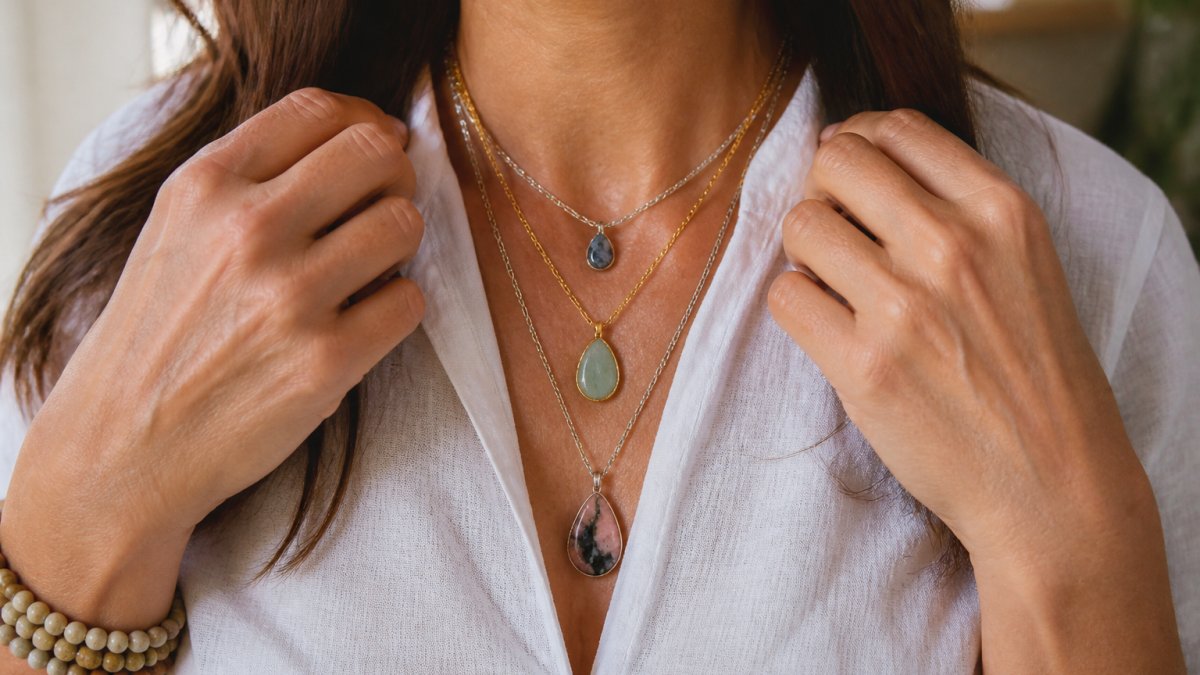
The most reliable approach is a three-length stack: a short chain at 16 inches, a mid-length piece at 18 to 20 inches, and a longer pendant at 22 inches or beyond.
A few more guidelines that hold up in practice:
- Keep one focal point. One large stone pendant plus two finer chains reads elegant; three statement stones read cluttered.
- Mix metals on purpose. Silver and gold together works when one metal dominates and the other appears once.
- Match the neckline. A 16-inch necklace sits above a crew neck; a 22-inch necklace balances a V-neck or an open collar.
- Vary texture, not just length. A beaded necklace with Navajo pearl beads or small stone accents adds contrast to a smooth pendant chain.
- Adjust for the office. A single pendant on a fine silver chain under a blazer looks polished for meetings; save the full stack for evenings and weekends.
That last point answers a question we hear often. Bohemian does not have to mean festival.
Common Buying Mistakes and What to Ignore
The biggest mistake is buying the photo instead of the piece. Listings shot under warm studio light make dull stones glow and plated metal look like solid gold.
What most guides miss is how much of the decision comes down to the listing itself. A seller who shows the back of the stone, names the material honestly, and lists the necklace length is telling you something about how they operate. One who hides the details is telling you something too.
Mistakes worth avoiding:
- Ignoring necklace length. A 16-inch chain and a 22-inch chain are completely different purchases. Check before you buy, especially for gifts.
- Assuming "natural" means durable. Some natural stones are soft and chip easily. Composite and stabilized materials exist for good reasons.
- Overpaying for a name. A brand label is not a quality guarantee. Judge the stone and the setting.
- Buying a full stack at once. Build a layered look one piece at a time so each addition actually works.
- Forgetting the gift details. For a jewelry gift, length, metal tone, and the recipient's existing pieces matter more than the box.
On the flip side, ignore claims that a stone will change your life. Plenty of buyers come to chakra-themed and spiritual jewelry purely for the look, and that is a perfectly good reason to buy. You will not feel out of place here.
Conclusion
The real challenge in buying stone jewelry online is not finding something pretty. It is telling a genuinely handcrafted piece from a convincing imitation, and knowing which details actually matter before you pay.
That is the standard we hold ourselves to at Bijouterie Mercantile. Our curated collection centers on bohemian elegance, with natural agate pieces like the adjustable Agate Stone Necklace and colorful stone designs such as the Cotton Candy Turquoise Pendant Necklace, both priced for everyday wear rather than special occasions.
Start with one stone that catches your eye, wear it often, and layer from there. Subscribe to our emails to hear when new pieces join the collection.
Frequently Asked Questions
What makes a stone necklace artisan-made?
Artisan-made means a person selected the stone, set it, and finished the piece by hand rather than a factory stamping out identical units. Look for visible wire wrapping, hand-set prongs or bezels, and small variations between pieces. A maker who can tell you where a stone came from and why they chose that cut is a strong signal. On a site like Bijouterie Mercantile, the Agate Stone Necklace at $10.00 and the Cotton Candy Turquoise Pendant Necklace at $5.00 show the adjustable and pendant construction details you can compare across listings.
How can you tell if a gemstone necklace is genuine?
Start with the listing language. Sellers of real stones name the stone and describe its natural variation. Composite or reconstituted materials should be labeled as such, and honest listings say so, like a composite turquoise pendant that states the material plainly. Check for temperature (real stone feels cool at first touch), weight, and internal banding or inclusions that do not repeat identically. Ask the seller directly about sourcing. If the answer is vague or the price is far below what the stone normally costs, treat it as decorative rather than precious.
How should you care for a natural stone necklace?
Keep stones away from perfume, hairspray, chlorine, and household cleaners, and put jewelry on last when getting ready. Wipe pieces with a soft dry cloth after wearing. Store each necklace separately in a pouch so harder stones do not scratch softer ones. Remove jewelry before swimming, showering, or heavy exercise. For silver chains, a polishing cloth restores shine without harsh dips. Porous stones like turquoise and opal should never soak in water. Following this routine is the simplest way to care for gemstone jewelry and keep color and finish intact for years.
How do you style a stone necklace with layered jewelry?
Anchor the look with one longer pendant, then add a shorter chain above it, keeping 2 to 3 inches between each layer so they do not tangle. Mix one bold stone with quieter pieces so the stone stays the focal point. A 16-inch necklace sits near the collarbone, while a 22-inch necklace layers well over a 16-inch chain. Vary textures, pairing a wire-wrapped pendant with a plain silver chain. Match metal tones loosely rather than perfectly, and let one colorful stone like turquoise or carnelian lead the composition.