

How to Understand Why Handmade Jewelry Costs More
Last Updated: November 4, 2026
Quick Summary
Handmade jewelry costs more because you are paying for the maker's time, skill, and materials rather than a machine's output. Artisan jewelers price pieces with a formula: materials plus labor plus overhead equals base cost, then base cost is doubled for wholesale and doubled again for retail. Small-batch makers also pay closer to retail for materials and spread studio overhead across dozens of pieces instead of thousands.
- A pair of earrings using $6 in materials, 45 minutes of labor at $25 hourly, and $2 consumables retails at $107.
- The pricing formula is materials plus labor plus overhead equals base cost, then base cost times two for wholesale and times two again for retail.
- A solo maker often spends 30 to 60 minutes on non-production tasks for every hour of direct production.
- Time a small batch of five pairs with a stopwatch and record each step separately to find where hours actually go.
- Ask what the beads, wire, and findings are made of and whether the closure is secured before buying.
Table of Contents
- The Real Reasons Handmade Jewelry Costs More
- The Jewelry Pricing Formula Every Artisan Uses
- How Labor Cost for Jewelry Making Adds Up
- Mass-Produced vs Handmade Jewelry: What the Price Difference Really Means
- The Hidden Costs of Small-Batch Production
- Why Craftsmanship and Design Integrity Matter
- The Psychology of Luxury Pricing and Perceived Value
- How to Choose Handmade Jewelry That Lasts
- Frequently Asked Questions
The Real Reasons Handmade Jewelry Costs More
Why handmade jewelry costs more comes down to one uncomfortable truth: you are not buying beads and wire, you are buying someone's hours. Handmade pieces are assembled one at a time, so the price reflects time, skill, and materials rather than a machine's output.
Below, we break down the actual cost structure, the pricing formula independent jewelers use, and the parts of the price tag most shoppers never see.
Labor and Time: The Biggest Cost Driver
The largest line item in any handmade piece is the maker's time. A single pair of beaded earrings can involve selecting matched beads, laying out the pattern, threading, knotting, securing the findings, and inspecting the finished result.
A maker's hourly rate also has to cover designing pieces that never sold, answering emails, and packing orders. A small studio prices all of that into a single object.
Materials and Overhead: Where the Money Goes
Material costs are the easiest part of a handmade price to understand and the easiest to underestimate. Small-batch makers buy beads, wire, and findings in modest quantities, so they rarely get the volume discounts a factory receives.
Overhead is the quieter cost. Studio rent, lighting, storage, equipment depreciation, and packaging all add up. A factory spreads those costs across thousands of units; an independent jeweler spreads them across dozens.
The Jewelry Pricing Formula Every Artisan Uses
Most artisan jewelers price with a simple, repeatable formula:
Materials + Labor + Overhead = Base Cost. Base Cost × 2 = Wholesale. Wholesale × 2 = Retail.
That doubling is not greed. Wholesale pricing leaves room for a retailer's margin, and retail pricing absorbs returns, marketing, and unsold pieces. A maker who skips the multipliers usually discovers the problem a year later, when the business has revenue but no profit.
The formula also explains why two similar-looking pieces can carry very different prices. One maker may use a higher hourly rate, work in a space with higher studio rent, or spend more time on finishing. The math is transparent once you know the inputs.
What Counts as COGS in Jewelry Making
Cost of Goods Sold (COGS) is the direct cost of producing each piece: beads, wire, findings, and components, plus the labor hours directly tied to making it. COGS excludes studio rent, marketing, and the owner's administrative time, those are operating expenses.
A common pattern among small studios is to track COGS per design in a simple spreadsheet: material cost per unit, minutes of direct labor per unit multiplied by the hourly rate, and a small allowance for consumables like glue, polishing cloths, and thread.
The Multiplier Math and What Each Layer Absorbs
The ×2 wholesale multiplier is not arbitrary. It has to cover operating expenses, studio rent, utilities, equipment maintenance, insurance, packaging, and the owner's non-production time, and still leave a margin. If operating expenses run 30% of wholesale revenue, a ×2 multiplier leaves roughly 20% as profit before taxes.
The ×2 retail multiplier covers the retailer's own costs: display space, staff, payment processing, markdowns, and returns. A retailer buying at wholesale typically needs a keystone (×2) markup to stay viable, which is why handmade pieces sold direct can price lower at retail and still be profitable, and why the same piece can look dramatically cheaper on a maker's own site than in a boutique.
Watch out: applying the multipliers to a base cost that omits the maker's own administrative hours produces a retail price that looks competitive but quietly pays the owner nothing for the hours spent on email, ordering, and listing management.
A Worked Example
Suppose a pair of earrings uses $6 in beads, wire, and findings, takes 45 minutes of direct labor at a $25 hourly rate ($18.75), and carries a $2 consumables allowance. Base cost is $26.75. Wholesale at ×2 is $53.50; retail at ×2 is $107. A maker selling direct at $107 keeps both margins, which is why direct-to-buyer pricing can undercut a boutique carrying the same design while still covering costs.
Why the Formula Beats Guesswork
The alternative is comparison pricing: looking at what similar pieces sell for and picking a number in that range. That fails because it ignores the maker's actual cost structure. A studio with high rent and slow handwork cannot profit at a price set by a hobbyist working from a spare bedroom. The formula forces the maker to know the inputs, and knowing the inputs is what makes a price defensible.
How Labor Cost for Jewelry Making Adds Up
Labor cost for jewelry making is calculated by tracking actual hours per piece and multiplying by a realistic hourly rate.
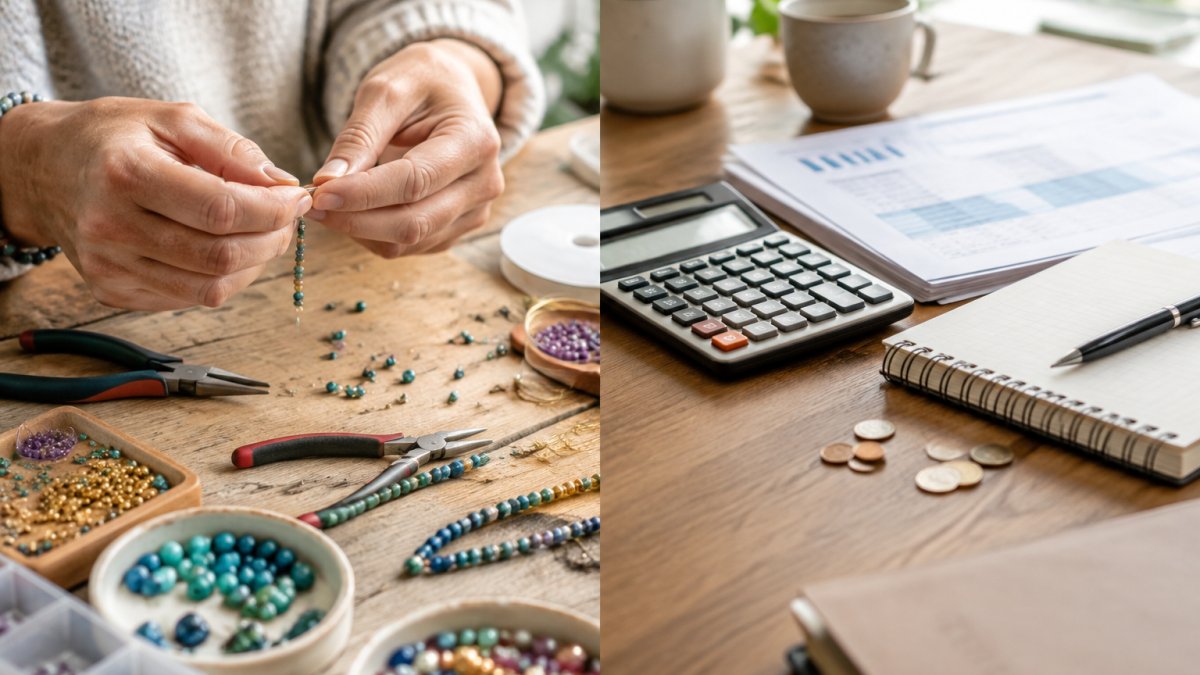
Consider what goes into a typical pair of handmade earrings:
- Selecting and matching beads so the pair looks balanced
- Laying out the pattern before threading begins
- Threading, knotting, and securing each bead
Each step is short. Together they add up to real time, and that time is the product.
Setting an Hourly Rate That Actually Covers the Work
The hourly rate is not the maker's take-home pay. It has to cover hours that never produce a sellable piece: design and prototyping, sourcing trips, photographing listings, answering emails, packing orders, bookkeeping, and remade pieces.
A practical approach is to set a target annual income, add operating expenses, divide by the billable production hours the maker can realistically work in a year, and use that as the floor for the hourly rate.
Tracking Actual Time, Not Estimated Time
Estimating build time from memory reliably undercounts. Time a small batch, say five pairs, with a stopwatch or app, record each step separately, and average the results.
Watch out: timing only the pieces that go smoothly produces a labor number that ignores rework, and rework is a real cost, a snapped thread or a mismatched bead pair can double the build time on a single unit.
The Non-Production Hours That Belong in the Price
Photography, listing copy, customer service, order packing, and inventory management are labor even though they do not touch the jewelry. Allocate a percentage of non-production time to each piece based on volume: 10 hours a week of non-production work across 20 weekly pieces means roughly 30 minutes belongs to each piece.
Why Two Makers Charge Different Labor Rates
Two studios can build an identical pair of earrings and arrive at very different labor costs. One may work in a high-rent studio; another may batch-produce components to cut direct minutes; a third may spend extra time on finishing because that finishing is the selling point. None is wrong, labor cost reflects the studio's cost structure and choices, which is why comparing labor rates across makers tells a shopper very little.
Mass-Produced vs Handmade Jewelry: What the Price Difference Really Means
Mass-produced vs handmade jewelry is not a comparison of quality versus cost, it is a comparison of two entirely different production models. A factory lowers unit cost by standardizing designs, buying materials at volume, and dividing labor across stations. A handmade studio does the opposite: it accepts higher unit cost in exchange for variation, control, and design integrity.
That trade-off has a visible result. Factory pieces are identical; handmade pieces carry small differences in bead placement, finish, and proportion, which is exactly what makes them feel personal.
If you are weighing whether the higher price is justified for your own wardrobe, our guide on how to decide if handmade gemstone jewelry is worth it walks through the decision in more detail.
The Hidden Costs of Small-Batch Production
Small-batch production carries expenses that never appear on a price tag. Buying materials in small quantities means paying closer to retail.
There is also the cost of inconsistency. A small studio cannot guarantee the exact shade of a stone will be available next season, so it absorbs the risk of discontinued materials, risk baked into the price of every piece that does sell.
For readers curious about how artisan stone pieces are sourced and valued, our handcrafted artisan stone necklaces buying guide explains the small-batch side of the equation.
Why Craftsmanship and Design Integrity Matter
Craftsmanship is the difference between a piece assembled to a spec sheet and a piece assembled by someone who chose every element.
That control shows up in the details: how a closure sits, whether the weight feels balanced, whether the finish holds up to daily wear.
Readers who want to see what that control looks like in practice can browse the handmade collection and compare the finishing across pieces.
The Psychology of Luxury Pricing and Perceived Value
Perceived value is shaped by far more than material cost. Scarcity, provenance, and the story behind a piece all influence what a buyer believes it is worth.
That narrative is not marketing fluff. It changes how the buyer experiences the object, and it explains why two pieces with similar materials can sit at very different prices and both find buyers.
If you are applying that lens to earrings specifically, our buyer's guide to authentic gemstone earrings covers what to check before you buy.
How to Choose Handmade Jewelry That Lasts
Durability generally comes down to materials, construction, and care. Before buying, ask what the piece is made of, how the findings are secured, and whether the finish will hold up to daily wear.
A practical checklist for evaluating a handmade piece:
- Ask what the beads, wire, and findings are made of
- Check whether the closure is secured and comfortable
- Confirm the piece is hypoallergenic if you have sensitive skin
For readers who want reassurance before investing, our article on whether handmade gemstone pieces are durable covers construction and care in depth.
| Question to Ask | What a Good Answer Sounds Like | Why It Matters |
|---|---|---|
| What are the materials? | Specific bead, wire, and finding types named | Signals honest sourcing |
| How is it constructed? | Knotting and closure method explained | Predicts longevity |
| How do I store it? | Dry, separate storage advised | Limits tarnishing |
| Is it hypoallergenic? | Nickel-free findings confirmed | Protects sensitive skin |
Frequently Asked Questions
How much should handmade jewelry cost?
Handmade jewelry prices vary widely based on materials, labor hours, and design complexity. A simple beaded piece might cost $8 to $15, while intricate stone work can run $50 or more. The key is that the price reflects actual time and materials, not a mass-produced markup. Handmade pieces do not always carry high prices, and handcrafted beaded earrings at Bijouterie Mercantile are listed from $9.00.
What is the 2:1:1 rule in jewelry?
The 2:1:1 rule is a common jewelry pricing formula: multiply your material cost by 2, add your labor cost, then add a 10% buffer for overhead and profit. For example, if materials cost $5, labor is $10, the wholesale price would be roughly $20. This formula helps artisans cover costs while staying competitive. It's a starting point, not a strict rule, since small-batch production often carries higher overhead.
Is handmade jewelry always more expensive than mass-produced pieces?
Not always. Mass-produced jewelry benefits from economies of scale, but it often uses cheaper materials and less durable finishes. Handmade jewelry can cost more upfront because of labor and small-batch sourcing, Some handmade pieces, like the $8.00 Twilight Dangle Earrings at Bijouterie Mercantile, are handcrafted and nickel-free.
What factors contribute to the labor cost of handmade jewelry?
Labor cost includes the artisan's hourly rate, time spent designing, sourcing materials, and assembling each piece. A single beaded earring can take considerable time to make, and that time adds up. Other factors include studio rent, equipment depreciation, and quality control checks. Unlike mass-produced items, handmade jewelry often involves one person handling every step, which increases the labor cost per piece.
The real test of a handmade piece is whether it still looks considered after a year of daily wear. At Bijouterie Mercantile, we build our collection around handcrafted, hypoallergenic designs like our $9 Pink Beaded Earrings and our Twilight Dangle Earrings, so bohemian style stays wearable rather than precious. Subscribe to our emails and be first to see new pieces as they arrive.
